How to Choose a Narrow Recliner for a Tall Person
A narrow recliner for a tall person needs enough seat depth, back support and footrest reach, even when its outside width is limited. Compare your seated measurements with the chair dimensions and check the full reclined footprint.
On this page (11 sections)
- How do you choose a narrow recliner for a tall person?
- What does “narrow” mean for a tall user's recliner?
- Why do seat depth and footrest reach matter?
- How do back height and head support affect tall users?
- How can you fit a recliner into a small room?
- Which of these narrow recliners suits a tall person?
- How should you set up and use a narrow recliner?
- How do you care for the upholstery and avoid common mistakes?
- What other measurements should you check before buying?
- How can you compare two chairs fairly?
- Which narrow recliner should a tall person choose?
A narrow recliner for a tall person needs to fit your hips while giving your thighs, back and lower legs enough support. Start with your body measurements and the chair's usable seating dimensions, then check whether its full footprint fits the room.
A slim outline alone doesn't guarantee a comfortable fit. Some chairs save space with narrow arms or a short seat, so compare the measurements that matter before choosing by appearance.
How do you choose a narrow recliner for a tall person?
Choose by matching your body to the seat and support dimensions, then confirm the outside width and reclined footprint fit your room. A compact frame only helps if you can sit back and support your legs.
Measure your hips across their widest point while seated. Measure from the back of your hips to the bend behind your knees, and note how much back and head support you need in your usual sitting position.
Use this checklist to compare chairs:
| What to measure | Why it matters |
|---|---|
| Outside width | Confirms the chair fits the available gap |
| Usable seat width | Shows the room between the arms |
| Seat depth | Helps you assess thigh support without pressure behind your knees |
| Seat height | Affects where your feet rest when you're seated |
| Back and head support | Shows where the chair may meet your torso and head |
| Expanded length | Shows how far the chair reaches when reclined |
Measure your room, too. Note the available width, depth and wall clearance, plus any doorway or tight turn along the delivery route.
If delivery weight matters, see how much a recliner chair weighs.
Our guide to how a recliner should fit your body explains how to compare seated measurements with chair dimensions. If you want a broader checklist for comparing styles and features, see how to choose a recliner.
What does “narrow” mean for a tall user's recliner?
A chair's outside width isn't the same as its usable seat width. Compare both, because thick arms can take up space between the outer edges.
Look for the seat width between the arms, not just the widest point of the frame. If the chair's overall width is compact but its seat is too narrow for your hips, it won't solve the fit problem.
A narrow chair may suit a smaller room, but don't trade away the support your body needs just to save a few inches. If your fit depends on exact measurements, use what size recliner is right for a tall man? to compare seat, back and overall dimensions.
What should a tall person measure on a narrow recliner?
For a narrow recliner for tall people, compare seat depth, usable width, seat height, back support and footrest reach. Your height is a useful starting point, but your seated measurements are a better way to check individual fit.
Measure the seat from the back cushion to the front edge, and check that the edge won't press into the bend of your knee. Compare seat width with your hip measurement and leave enough room to sit without your thighs being squeezed by the arms.
Why do seat depth and footrest reach matter?
Seat depth and footrest reach affect how your legs are supported when you sit and recline. A chair can look tall enough yet still leave your thighs or lower legs without the support you want.
If the seat ends well before your knee bend, your thighs may have little support. If it reaches too far, its front edge can press behind your knees.
When possible, compare the usable seat depth with your seated thigh measurement.
Check the footrest separately. A long open footprint doesn't necessarily mean the footrest will support your lower legs well, so look for a footrest measurement or a clear description of how it extends.
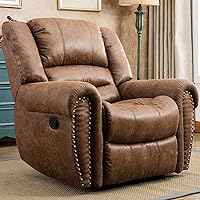
The CANMOV chairs provide useful figures for this comparison: their seat is 22 in wide by 20 in deep, the seat is 18 in high, and the expanded length is 65 in. These measurements can help you decide whether to keep considering them or move on to a chair with a different fit.
The second CANMOV option has matching seat dimensions and expanded length. Choose between them based on the color and style that suit your room, rather than expecting a different fit.
How do back height and head support affect tall users?
Check where the chair's back reaches on your body, rather than relying on its overall height. A tall chair can still leave your head unsupported if its back shape or cushions don't match your seated posture.
When possible, compare the backrest with your seated torso and head height. Also notice whether a separate head cushion changes how far back you can sit, since a large cushion may shift your posture forward.
The CANMOV chairs have overstuffed pillows at the head and back. The Homall chair has a back dimension of 19.2 x 24.8 in, which gives you another measurement to compare with your own back and shoulders.
If you want to compare chairs selected around height, see best recliners for tall people. If powered adjustment is important, best power recliners for tall people is the next useful comparison.
How can you fit a recliner into a small room?
Measure the closed dimensions and the fully open footprint before choosing a chair. The guide to home theater recliner size covers room and chair measurements.
A narrow recliner can still block a walkway or door when its footrest is extended.
Use painter's tape or paper to mark the chair's outside width and depth on the floor. Then mark the expanded length in front of it, and check whether you can walk past, open nearby doors and reach tables without squeezing around the footrest.
Check wall clearance as well. A wall hugger can help when space behind the chair is limited.
The style name doesn't tell you the clearance for a specific model. Compare the model's dimensions with your room.
See how a wall hugger recliner works for the basic mechanism, or compare options in best wall hugger recliners for tall people. Measure the delivery route, too, since doorways, tight turns and stairs can prevent a chair from reaching its final spot.
Which of these narrow recliners suits a tall person?
The CANMOV chairs are the better starting point if you need more seat width or a higher capacity than the Homall offers. Their two color options have identical seat and expanded dimensions, so choose based on room style after checking whether those measurements suit you.
Both CANMOV options measure 40 in wide and have a stated capacity of 350 lb.
Their manual lever raises the footrest, and the back reclines to a maximum of 140 degrees. These are practical choices if you want a manual chair and the 22 x 20 in seat works for your body.
Skip the CANMOV chairs if a 20 in seat depth is too short for your thighs, or if a 40 in outside width won't fit the room. The 65 in expanded length also needs to fit your available floor space.
The Homall is the better option when minimizing outside width matters most and its smaller seat and lower capacity meet your needs. It measures 24.4 in wide when closed, has an 18.8 x 20.2 in seat and a 265 lb maximum capacity.
Skip the Homall if you need more seat width, a capacity above 265 lb, or back support that matches a larger seated torso. Its back measures 19.2 x 24.8 in, so compare that carefully with your own height and preferred support.
The Homall reclines from 90 to 160 degrees and has a metal frame. Its smaller footprint makes it worth comparing for a tight room, but its overall width doesn't override the need for a comfortable seat fit.
How should you set up and use a narrow recliner?
Set up the chair on a level floor with enough space to open the footrest fully. Follow the included assembly instructions, and make sure all required parts are secure before sitting down.
With a manual recliner, check that you can reach and operate the lever from your normal seated position. The CANMOV chairs use an arm lever to raise the footrest; to close it, sit upright and use your heels to press the middle of the footrest.
Keep the chair's full movement area clear of cords, toys, pets and low tables.
Don't lean to one side to reach an item while the chair is open, and avoid leaning forward in an open recliner. Those positions can make the chair less stable.
Before placing the chair in a shared room, show other household members where the footrest moves and how to close it. Check that the chair doesn't block an exit or the route between commonly used furniture.
How do you care for the upholstery and avoid common mistakes?
Care depends on the upholstery and the care instructions for your chair. The CANMOV models use faux leather, and Homall describes its PU leather as easy to clean; follow the care instructions that come with the chair and use products meant for its material.
Wipe up spills promptly with a soft cloth. Avoid soaking the upholstery or using harsh cleaners unless the care instructions allow them, since strong products can damage a surface finish.
A common buying mistake is treating outside width as a complete fit check. Another is comparing a chair's closed depth with the room, then discovering the footrest blocks a walkway when extended.
Don't assume a tall back means good head support, or that a long reclined footprint guarantees a long footrest. Compare each measurement separately, and skip a chair when a dimension you need is missing or doesn't suit your body.
What other measurements should you check before buying?
Check weight capacity, arm height and chair dimensions alongside seat fit. These details can rule out a chair that otherwise looks suitable.
The CANMOV models have a 350 lb capacity and are 40 in wide. The Homall has a 265 lb maximum capacity and a 24.4 in closed width; its seat measures 18.8 x 20.2 in.
Those figures show why outside width alone isn't enough. The Homall is narrower overall, but its seat is also narrower, so compare its usable space with your hip measurement.
If you need a higher capacity, use what to look for in a recliner for a heavy person and compare best recliners with a 500 lb capacity. For a chair in a smaller room, best recliners for bedrooms may help you compare options suited to bedroom placement.
How can you compare two chairs fairly?
Use the same checklist for every option: outside width, usable seat width, seat depth, seat height, back support, footrest reach and expanded length. Keep your body and room measurements beside the chair dimensions so you can rule out poor fits early.
| Fit check | Your measurement or need | Chair measurement to compare |
|---|---|---|
| Hip room | Seated hip width | Usable seat width |
| Thigh support | Hip to knee bend | Seat depth |
| Foot support | Lower-leg length | Footrest reach or open dimensions |
| Upper-body support | Seated torso and head height | Back and headrest dimensions |
| Room fit | Available width and depth | Closed and expanded dimensions |
| Capacity | Intended user's needs | Stated weight capacity |
If a chair doesn't give a measurement you need, ask the brand or seller before relying on an estimate. Chairs with similar outside dimensions can have different seat and back proportions.
Which narrow recliner should a tall person choose?
For a narrow recliner for a tall person, choose the CANMOV if its 22 x 20 in seat, 65 in expanded length and 350 lb capacity suit your body and room. Pick the Homall if its narrower 24.4 in closed width solves a space problem and its 18.8 x 20.2 in seat and 265 lb capacity are enough.
If neither chair gives you the leg support or back fit you need, keep comparing instead of choosing by overall width. Use how to choose a recliner to check the other fit and feature decisions before you buy.
Frequently asked questions
What should a tall person check on a narrow recliner?
Check usable seat width, seat depth, back support and footrest reach together. A compact chair can fit the room yet leave your knees unsupported or your feet beyond the footrest.
Compare these measurements with your seated body measurements, then confirm the chair's full open dimensions fit the room.
Is a 20 inch seat deep enough for a tall person?
A 20 in seat may feel short if your thighs need more support, but height alone doesn't tell you what will fit. Measure from the back of your hips to the bend behind your knees, then compare that distance with the usable seat depth.
The seat edge should not press into your knee bend.
How much space does a recliner need when open?
Use the chair's expanded length or open dimensions, plus room to move around it safely. Recline designs vary, so don't estimate clearance from the closed depth alone.
Measure from the wall behind the chair to the front of the fully open chair, then check doors, tables and walkways.
Can a narrow recliner support a tall person?
It can if its seat, back and footrest fit your body, but a narrow outside width doesn't prove a good fit. Compare usable seat width and depth, back support and reclined leg support.
Check the chair's stated weight capacity against the intended user's needs, too.