How to Choose the Right Home Theater Recliner Size
Choose a home theater recliner size by measuring the seat, the chair at full recline and the clear paths around it. Then check row spacing, doorway access and how the chair's features affect your layout.
On this page (7 sections)
- What measurements matter for a home theater recliner chair size?
- How much space does a recliner need to open?
- How do you plan rows and walkways?
- How can you check the seat fit?
- What should you check before choosing a chair?
- How do doorways and delivery affect the size choice?
- How do you choose the right home theater recliner size?
Choose a home theater recliner chair size by measuring the seat, full recline depth and walkways before arranging the room. A chair that fits while upright can still block a row when its footrest opens or its back moves.
Start with the people who will use it. Then map the chair's open footprint, the path to each seat and the route into the room.
For general sizing basics, see What Size Recliner Do I Need? Numbers to Know.
What measurements matter for a home theater recliner chair size?
The key measurements are outside width, closed depth, full recline depth and seat dimensions. Together they show whether the chair fits the room and the person using it.
Measure the space where the chair will stand, not just the seat cushion. Armrests, bases and footrests add to its footprint.
| Measurement | What it tells you | Where to use it |
|---|---|---|
| Outside width | Space the chair takes across a row | Row layout and gaps between chairs |
| Closed depth | Front-to-back space when upright | Room footprint and delivery route |
| Full recline depth | Space needed when open | Row spacing and wall clearance |
| Seat width and depth | Space available for the sitter | Personal fit |
| Seat height | Distance from floor to seat | Ease of sitting down and standing up |
| Back height | Support area behind the sitter | Fit and viewing position |
Dimensions can be described in different ways, so check what position each number represents. A chair's open length may not match its closed depth, and a seat measurement is not the same as outside width.
Our how to measure a recliner chair guide explains where to measure across the chair. For room planning, also record the wall, screen and doorway dimensions.
How much space does a recliner need to open?
A recliner needs its full open footprint plus clearance to nearby walls, furniture and walking routes. Measure the chair fully reclined, then confirm the distance it needs from the wall.
Some designs move forward as they recline, while others need more space behind the back. Do not assume that two chairs with similar closed dimensions will open in the same way.
Mark the proposed chair position with painter's tape, then add the open area shown in the chair's dimensions. Leave a clear path around the marked footprint so a person can reach the seat without stepping over a footrest.
If the exact recline clearance is not published, check with the maker before setting row spacing. Do not estimate from the chair's upright depth.
How to plan a recliner chair for home theater size
Plan a recliner chair for home theater size around the open chair and the people moving past it. Use the chair's full recline dimensions first, then add usable space for access.
- Measure the room's usable width and depth, including doors and fixed furniture.
- Mark the chair's outside width and closed depth on the floor.
- Extend the outline to its full recline dimensions.
- Mark a walking route to and past the seats.
- Repeat for each chair and row.
- Check the route to the room, including turns and the narrowest doorway.
A layout that works on paper can feel crowded if people need to pass in front of open footrests. Test the arrangement with temporary floor marks and walk through it from each entrance.
How do you plan rows and walkways?
Arrange rows so every chair can recline and people can reach their seats without squeezing past an open footrest. Check both the gap between rows and the route along each row.
Start with the chair closest to the screen, then add the next row using the front and back edges of the fully open chairs. Preserve a walkway that remains clear when every seat is occupied and reclined.
Keep stairs, doors and exits clear. If you use a raised platform, allow for safe access to it and make sure the step does not narrow the route between rows.
For a compact room, compare a single row with smaller chairs before adding another row. A room can fit more seats on a sketch than people can comfortably use.
What changes when you add cup holders or consoles?
Cup holders and center consoles can increase the space needed between seats. Include them in the layout and check whether a person can reach them with the chair open.
A chair with built-in storage may reduce the need for a separate table, but it still needs room to open. Leave enough space to place a drink, retrieve a remote or get in and out of the seat without bumping another chair.
How can you check the seat fit?
A good seat fit lets the sitter rest their feet on the floor when upright and reach the footrest comfortably when reclined. Compare the seat width, depth and height with the main user.
Seat depth matters as much as width. If the seat is too deep, a shorter sitter may have to lean forward to reach the back; if it is too shallow, a taller sitter may not have enough thigh support.
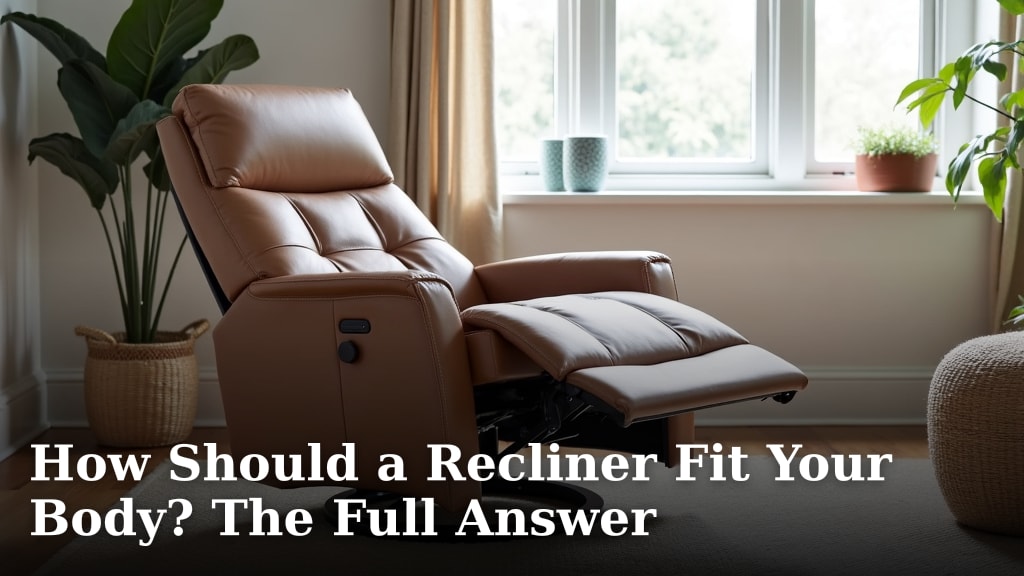
For more detail, use How Should a Recliner Fit Your Body? The Full Answer.
Shorter users can also read What Size Recliner for a Short Person? Measure It Right.
Does one chair size fit every movie room?
No. A chair that suits one sitter and one floor plan may not suit another, even if both rooms have similar floor space.
Match the seat to its regular user first. Then choose the number of seats that still leaves room to recline, move through the room and reach the exits.
What should you check before choosing a chair?
Check fit, open dimensions, access and useful features before settling on a model. A small feature can affect the layout if it needs power, space or regular reach.
For example, a lift chair's upright assistance changes how you may use its remote and where you want it placed. A replacement remote is only useful if it matches the chair's connection.
MCombo gives a recommended user height of 5 ft 1 in to 5 ft 9 in for this chair. Its dual USB outlets are intended for low-power devices, and its two cup holders and side pockets need to be reachable from the planned seat position.
The chair's listed dimensions are 35.8 x 35.2 x 44.5 in, and its depth is 30.7 in. Check the full open footprint and the required wall clearance for your setup before assigning its row position.
Homall gives a seat height of 17.9 in and seat dimensions of 18.8 x 20.2 in. Its reclining range is 90° to 160°, so plan for the chair's open length when setting the distance to the next row.
The Fromann remote uses a 2-button, 5-pin connection and works with one motor. Its size does not determine chair spacing, but checking compatibility can help you plan controls for a powered seat.
How do doorways and delivery affect the size choice?
The chair must fit through every doorway and turn on its route to the theater, not only in its final position. Measure the narrowest point and compare it with the chair's dimensions in the way it will be moved.
Include stair landings, hallway corners, door handles and any packaging that will remain around the chair during delivery. Check whether the chair can be carried in separate pieces if the route is tight.
Recliners can be heavy, so include moving and setup in your plan. See How Much Does a Recliner Chair Weigh? when comparing the handling needs of different styles.
After you settle the seats, decide whether a separate footrest or table is still needed. An ottoman can add flexibility, but it also takes floor space and should not obstruct a walkway.
How do you choose the right home theater recliner size?
Choose a home theater recliner size by matching the seat to its user, then fitting the open chair into the room with clear routes around it. If the open footprint blocks a walkway, reduce the number of seats or choose a different chair shape.
Measure the delivery route before ordering, and confirm the exact recline clearance if the room has little space behind the chair. A layout is ready when every seat fits, opens fully and leaves an easy path to each row.
Frequently asked questions
How much space should go behind a home theater recliner?
Leave enough room for the chair to reach its full recline position without touching a wall or blocking a path. The needed gap depends on the chair's design, so measure its full recline depth and check the maker's clearance guidance.
Keep a clear route for people entering or leaving the row.
How wide should a home theater recliner be?
Choose a seat width that lets you sit comfortably with your arms resting on the armrests, then include the full outside width in your row plan. Add room between chairs if you want a shared walkway or space to reach cup holders.
Measure each model because arm styles change the overall width.
Can recliners go in two rows?
Yes, if each row has room for full recline, a usable walkway and clear sightlines. Measure from the front of the rear row to the back of the row ahead with both chairs open.
A riser may help sightlines, but it does not replace safe steps and clear exits.
Should I measure a recliner open or closed?
Measure both positions. Closed dimensions help with delivery and the chair's footprint, while open dimensions show how much room it uses when reclined.
Also measure the doorway route, seat width and depth, and any wall or walkway clearance the chair needs.
What should I check before buying a home theater recliner?
Check seat fit, outside width, closed depth, fully reclined depth and the clearance needed behind or in front. Confirm the chair fits through the delivery route and leaves an open path when used.
For power or lift models, include cords, controls and any needed access to outlets.