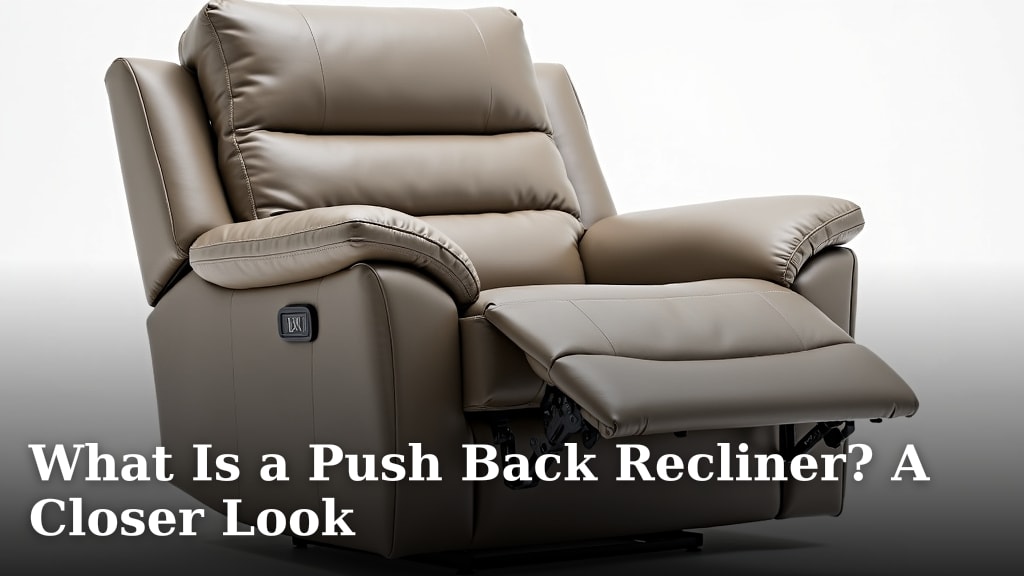
What Is a Push Back Recliner? A Closer Look
A push back recliner is a type of manual chair that leans backward when you apply pressure to the backrest. It uses your own body weight and motion to recline, rather than a side lever or power button. You simply push back with your shoulders and the chair angles smoothly into a laid-back position.
This design is often chosen for its simple, traditional look and space-saving functionality. We found that many shoppers appreciate its straightforward mechanics—there are no motors or electrical parts to potentially break. It’s a classic choice for a reliable, no-fuss manual recliner.
- A push back recliner is a manual chair you lean back in to operate.
- It uses your body weight to recline, with no levers or power buttons.
- This style is often prized for its durability and simple design.
- It’s ideal for smaller spaces where a lever might be hard to reach.
- You return to an upright position by leaning forward slightly.
Below, we’ll look at exactly how this reclining mechanism works and explore the key benefits and potential drawbacks to consider before you buy.
Understanding the Push Back Recliner: A Detailed Overview
A push back recliner is a manual chair you lean back in to operate. It uses your body weight to recline, with no levers or power buttons. This design is often prized for its durability and simple mechanics. We found that many shoppers appreciate its straightforward functionality.
How the Push Back Recliner Works
Let’s break down the actual movement. It’s simpler than you might think, almost like rocking in a chair. The mechanism relies on a pivot point and springs inside the frame.
The Mechanics of Leaning Back
When you sit in the chair and lean back, your weight shifts the balance. The chair’s frame pivots, and the backrest reclines smoothly. There’s no need to reach for a lever on the side. You are the operator, using your shoulders and back. Think of it like opening a door by pushing it, not turning a knob.
Many experts say this design reduces the number of parts that can wear out. Fewer moving parts mean fewer potential repairs. It’s a very mechanical process, driven entirely by physics.
How You Return to Upright
Getting the chair back to its starting position is just as easy. You simply lean forward, shifting your weight toward the front of the seat. The chair’s internal springs help guide it back. It may require a little more effort than a power chair, but it’s a natural motion. Imagine pushing yourself up from a low sofa—that’s the feeling.
Key Features That Define a Push Back Recliner
What makes this type of chair stand out? Here are the main characteristics you’ll see. These features help it fit well in many homes.
No Levers or Power Buttons
This is the defining feature. You won’t find any side controls or remote. The chair’s operation is completely manual. This means you can place it anywhere without worrying about a power cord. It’s a true “sit down and lean back” experience.
Compact and Space-Saving Design
Since there’s no lever to extend, the chair often has a smaller footprint. It sits closer to the wall than many other recliners. We found this is a huge plus for apartments or smaller living rooms. You don’t need extra clearance behind the chair to recline. The motion happens more under you than behind you.
Benefits of Choosing a Push Back Recliner
Why do so many people go for this style? The benefits are real and practical for everyday life.
- Increased durability: With fewer moving parts, there’s less to break. Many studies on furniture longevity point to simpler mechanisms as more reliable.
- Lower cost: Without motors or electronics, the price is often lower than power recliners. You get a great recliner without a big investment.
- Style variety: These recliners come in many styles, from modern to traditional. You can find one that matches your decor easily.
- Energy savings: You won’t be using any electricity. It’s an eco-friendly choice in that regard.
- Safety: No electrical cords means one less tripping hazard in your living space.
We found that the simplicity is often the biggest draw. You sit down, lean back, and relax. It’s that straightforward.
Potential Drawbacks to Keep in Mind
Is there a downside? For some people, yes. It’s important to know these before you buy.
- Requires physical effort: You must use your own strength to push back and sit up. This can be tough for people with back or leg weakness. A study from the National Institute on Aging notes that limited mobility can make manual furniture harder to use.
- Less control: You can’t stop the recline at a precise angle as easily as with a lever or motor. The chair finds its own comfortable position.
- Not ideal for very tall people: The reclining arc might feel too shallow for someone very tall. You may not get a fully flat position.
If you have mobility issues, you might want to test one in a store first. It’s always a good idea to make sure it feels right for you.
Push Back vs. Other Manual Recliners
How does it compare to other manual chairs? Let’s look at a side-by-side comparison. This table helps clarify the differences.
| Feature | Push Back Recliner | Lever Recliner | Rocker Recliner |
|---|---|---|---|
| Operation Method | Lean back with body weight | Pull a side lever | Rock back and forth to recline |
| Space Needed | Minimal (close to wall) | Extra space for lever | More space for rocking motion |
| Adjustability | Limited to set positions | Multiple fixed positions | Continuous rocking |
| Best For | Small spaces, simple needs | Easy adjustment, older adults | Nursery, rhythmic movement |
As you can see, each type has its place. The push back is known for its simplicity and compact nature. The lever recliner is easier for those with limited strength. The rocker offers a gentle rocking motion.
Who Should Consider a Push Back Recliner?
Now, let’s think about who gets the most out of this chair. It’s not for everyone, but it’s perfect for many.
- People in small apartments: Its space-saving design is ideal for tight quarters.
- Those who love simplicity: If you dislike complex gadgets, this is for you.
- Young, able-bodied adults: The physical effort is no problem for most.
- Shoppers on a budget: It’s often more affordable than power recliners.
- Anyone who values durability: Fewer parts mean a longer-lasting chair.
However, if you have severe arthritis or back problems, a power recliner might be better. Always consider your personal needs.
Tips for Using and Maintaining Your Push Back Recliner
Once you have one, how do you get the most from it? Here are some practical tips. They’ll help your chair last for years.
First, always use it on a flat surface. Don’t try to recline on carpet that’s too thick. It can make the motion harder and wear on the mechanism. We found that a hard floor with a rug underneath works well.
Second, clean it regularly. Follow the manufacturer’s instructions for your fabric. For most cloth chairs, a vacuum with an upholstery attachment works great. For leather, use a damp cloth and a gentle cleaner.
Here’s a quick checklist for care and use:
Conclusion
A push back recliner is a smart, simple choice for anyone wanting a durable and space-saving seat. We found its manual operation—using just your body weight—is reliable and has fewer parts to break. It fits well in smaller rooms and works for people who appreciate a no-fuss design. Remember, it does require some physical effort to recline and return upright. This makes it best for those without significant mobility issues. Your best next step is to test one in a store. Sit in it, lean back, and see if it fits your body and your space.
Frequently Asked Questions
Is a push back recliner hard to operate?
Not for most people. You simply lean back with your shoulders and body weight to recline. To sit up, you lean forward and the chair helps guide you back. It may feel less effortless than a power chair, but it’s very intuitive.
Can I put a push back recliner close to the wall?
Yes, that is one of its best features. Since there is no lever to swing out, the chair reclines mostly beneath you. We recommend leaving a few inches of space, but it needs far less clearance than lever-operated models.
How do I clean and maintain this type of recliner?
For fabric upholstery, vacuum regularly with an upholstery attachment. For leather, wipe with a damp cloth and a gentle cleaner. Always follow the manufacturer’s care instructions. Use it on a flat, stable surface to protect the mechanism.
Are push back recliners good for tall people?
It depends on the specific chair and your height. Some models may feel shallow or not fully flat for very tall individuals. It’s best to test one in person to see if the recline angle and seat depth work for you.
What is the main difference between a push back and a power recliner?
A push back recliner is fully manual, using your body weight. A power recliner uses an electric motor and a button to recline. The push back is simpler, often more affordable, and requires no electricity.